Federal Policy
Head Start
Proposed Federal Changes Could Significantly Impact Head Start’s Effectiveness
On August 6, 2026, the U.S. Administration for Children and Families (ACF) unveiled a Notice of Proposed Rulemaking (NPRM) containing the most significant rewrite of federal Head Start standards since the program’s inception in 1965. While this proposal does not change Head Start funding, it would substantially affect how services are delivered. This could have significant impacts on Head Start’s proven ability to support children’s school readiness and successful life outcomes.
This proposal is the first step in the federal rulemaking process. It is not final and may be revised before taking effect. Until that time, programs remain open, services continue under current standards and families can enroll as usual.
How Does the Proposed Rule Change Affect Head Start?
Replaces national standards with state and local standards, potentially creating a system in which the quality of Head Start services could vary greatly.
Increases pressure on Head Start programs by eliminating standardized guidance, encouraging reduced staffing and limiting what programs can spend on their administrative needs.
Impacts program effectiveness for children and families by making parental and family engagement activities optional features of Head Start programs, creating more barriers to enrollment and emphasizing English-only instruction.
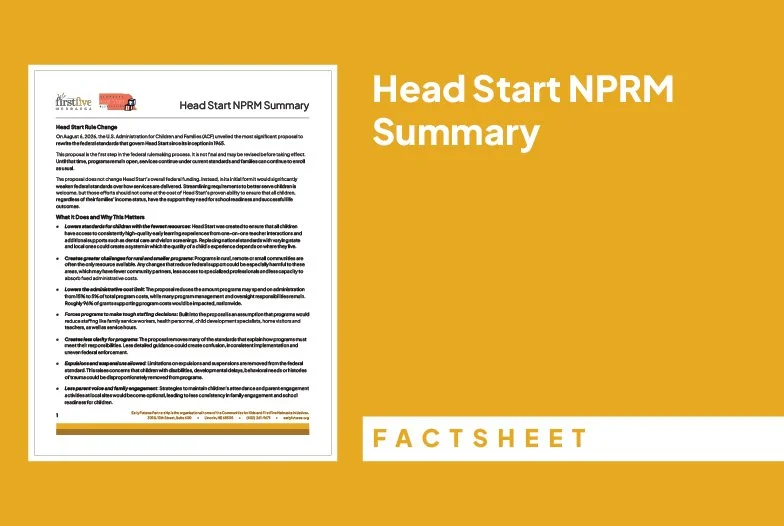
For a more detailed breakdown of the components of the proposed rule change, read the Head Start NPRM Summary published by First Five Nebraska and the Nebraska Head Start Association.
Head Start in Nebraska
Head Start is a crucial part of our national and state-level early childhood infrastructure. Head Start serves 700,000 children nationally. In Nebraska, Head Start programs:
Offer comprehensive nutritional, medical and developmental supports for children in 64 of Nebraska’s 93 counties.
Served a total of 5,425 children and 136 expectant mothers from 4,834 during the 2024-25 program year.
Employ more than 2,000 staff including teachers, home visitors, disabilities coordinators and other professionals working together to support children’s healthy development.
Source: “Head Start’s Impact in Nebraska in 2024-25.” Nebraska Head Start Association.
Take Action
Read Our Analysis
Find out more about the various provisions included in the Head Start Notice of Proposed Rulemaking.
Learn More
Read our blog post on the Head Start NPRM to better understand how it could affect children and families in our state and nation.
Submit a Comment
Learn more about how to submit your comment on the proposed Head Start rule change on the Federal Register website.
H.R.1 and Medicaid
Medicaid participation is critical to the well being of thousands of Nebraskans, especially children
Medicaid is a vital source of health coverage for thousands of Nebraskans, including children, pregnant women and low-income working families. Access to Medicaid helps ensure that individuals can receive care and manage their health conditions without facing overwhelming financial burdens. Medicaid coverage also supports rural hospitals and health care providers across Nebraska, helping to maintain care in communities throughout the state while contributing to healthier families and a stronger workforce.
H.R. 1’s Medicaid cuts will have cascading effects in Nebraska over 10 years and beyond
On July 4, 2025, H.R.1 (also known as the “One Big Beautiful Bill”) was signed into law—a development that will send shockwaves through Nebraska families and communities as it fundamentally restructures Medicaid eligibility, financing and operations.
Here’s how it will affect Nebraska:
-
Shifts greater economic burdens onto our state budget, which already faces a projected significant shortfall in 2027.
Pressures Nebraska lawmakers to either maintain current levels of coverage by cutting funding to other essential programs, or allow as many as 24,300 Medicaid expansion adults and 3,000 or more children to lose access to health care.
Medicaid is Nebraska’s single largest federal grant category, representing 47% of all federal funding received. Out state is simply not positioned to absorb a federal funding reduction on this scale without triggering dire social and economic consequences.
-
Requires states to re-verify the eligibility of Medicaid beneficiaries every six months instead of once per year.
Imposes more stringent work requirements for Medicaid beneficiaries, despite the fact that 92% of recipients are either already working, or are caregiving, ill, disabled or in school.
Ends automatic re-enrollment in the ACA Marketplace and reduces supports that help people understand and navigate their coverage options.
These measures will create additional administrative and staffing costs for our state and cause more Nebraskans to lose coverage due to paperwork issues, not ineligibility. This kind of red tape does not increase accountability or efficiency. It creates barriers that result in more medical debt and worse health outcomes, while driving up uncompensated costs for Nebraska’s health care providers.
-
Restricts our state’s options to leverage provider taxes—fees used to draw down federal Medicaid dollars—even as health care costs continue to rise. This shifts more of the costs of Medicaid coverage directly onto state budgets.
Caps and reduces State Directed Payments (SDPs), a tool Nebraska uses to support hospitals and other health care providers by directing dollars where they’re needed most.
Taken together, these changes threaten the sustainability of health care in Nebraska, especially for providers in rural areas who rely heavily on Medicaid funding to deliver services.
Medicaid in Nebraska
Medicaid covers 32% of all Nebraska children.
Medicaid pays for 38% of all births in Nebraska and helps ensure access to prenatal, maternity and postpartum care.
24,300 Medicaid expansion adults and 3,000 children in Nebraska are at risk of losing health care coverage due to Medicaid cuts.
Medicaid covers 28% of child care workers nationally.
Sources: See FFN’s policy brief “H.R. 1: How the ‘One Big Beautiful Bill will Impact Nebraska Mothers and Families who Receive Medicaid and SNAP.”
Take Action
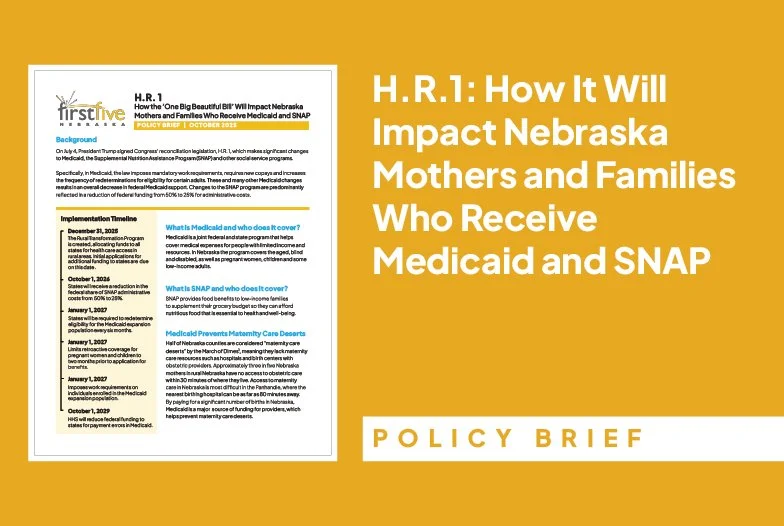
Educate Yourself on H.R.1
Learn more about Medicaid provisions in H.R.1 and their impact on Nebraskans.

Correct Misinformation
Learn how to recognize and respond to common misconceptions about Medicaid.
Contact Your Delegates
Ask your federal delegates to work together to minimize the fallout of H.R.1.
WIC Program
WIC Provides Crucial Nutritional Supports to Mothers and Children
The federally funded WIC program—the Special Supplemental Nutrition Program for Women, Infants and Children—strengthens health outcomes for thousands of Nebraska women and children in low-income families. The program provides nutritious foods, nutrition education, breastfeeding support and referrals to health care and social services. These supports are likely to contribute to lower rates of pre-term delivery, low birth weight and infant mortality, better preventative care and immunization, improved school readiness and stronger maternal-child health outcomes overall.
Potential Cuts to WIC Funding Threaten the Reach and Impact of Services in Nebraska
In June, 2026, the U.S. House of Representatives passed an appropriations bill that proposes slashing overall WIC funding by $200 million. Specifically, the bill would cut deeply into allocations for fresh fruits and vegetables, significantly reducing access to healthy produce for pregnant or postpartum mothers and their children.
Given that over 154,000 Nebraska households experienced food insecurity in 2021-23, we cannot afford to reduce access to nutritional benefits that can offset Nebraska’s rates of infant and maternal motality, low birth weight and other hazards to the health and wellbeing of mothers and children.
WIC in Nebraska
154K Nebraska households experienced food insecurity or very low food security in Nebraska in 2021-23.
Served over 28,000 infants and children under age 5 and 7,700 pregnant and postpartum women (2024).
Average monthly value of WIC food benefits in 2024 was $76.49 per Nebraska participant vs. $81.49 nationwide in 2024.
In Nebraska, 43.8% of eligible pregnant women and 55.2% of elible 1- to 4-year-olds participated in WIC in 2023.
Only about 60% of eligible Nebraskans participated in WIC, meaning that 24,000 eligible individuals missed out on crucial health and child development supports (2023).
Sources: See FFN’s factsheet “The Importance of the Women, Infants and Children (WIC) Program in Nebraska.”
Take Action
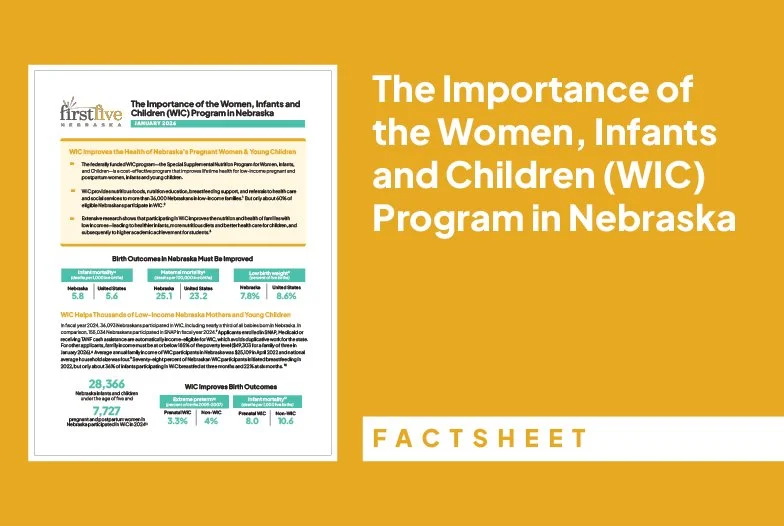
Learn More
Download our factsheet on the importance of the WIC program in Nebraska.

Take to Your Socials
Spread the word on social media about WIC and how it benefits our state. Be sure to use the #ProtectWIC hashtag.
Contact Your Delegates
Call or write to our state’s federal delegates to encourage them to strengthen their support for the WIC program.
Follow FFN on Social Media