State Policy
Medicaid Work Requirement Exemptions
Work Requirements Are Now in Effect for Adult Medicaid Expansion Members
What does that mean for Nebraska’s mothers and young families?
The federal government’s Medicaid work requirements went into effect in Nebraska on May 1, 2026, making us the first state in the nation to implement these changes in compliance with H.R.1. This means current and new enrollees of Medicaid expansion must participate in work, approved work programs, community service or education for at least 80 hours per month, unless they qualify for an exemption.
Pregnant Individuals or Parents with Young Children Are Exempt from Work Requirements
New Medicaid applicants and current enrollees are exempt from work requirements if they are:
Pregnant
Postpartum (up to 12 months) and had Medicaid while pregnant
A parent or caretaker of a child age 13 and under
It is important that individuals take the necessary steps to confirm exemption in order to receive coverage.
Did You Know?
In Nebraska, 24,300 Medicaid expansion adults and 3,000 children are at risk of losing health care coverage due to Medicaid cuts.
Of all persons enrolled in Medicaid in Nebraska, 46% are children.
Medicaid pays for 38% of all births in Nebraska and helps ensure access to prenatal, maternity and postpartum care.
How to Establish a Work Requirement Exemption
New Medicaid Applicants
Individuals newly applying for Medicaid must indicate if they are pregnant or have dependents age 13 or younger at home when completing the work exemption application.
If pregnant, the applicant must indicate the expected due date on their work exemption application.
Current Medicaid Enrollees
Current enrollees who become pregnant must report this to the Nebraska Department of Health and Human Services (DHHS) to claim a work exemption.
Any change in an enrollee’s eligibility status must be reported through the iServe portal, by calling DHHS or by visiting a local DHHS office in person.
Any change in status that could lead to an exemption from work requirements must be reported to DHHS as soon as possible to minimize the risk of losing coverage.
More information About Medicaid Work Requirements
To learn more, check the following resources at Nebraska DHHS.
Take Action
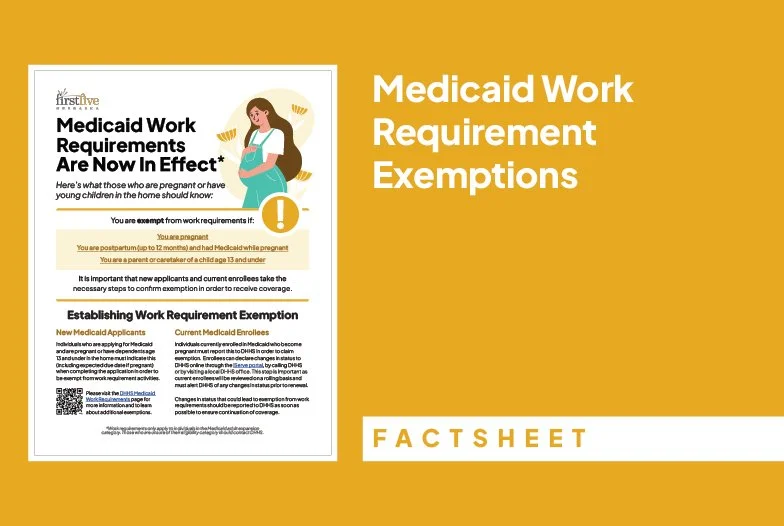
Circulate Information
Share our factsheet on Medicaid work requirement exemptions for mothers and families with young children.
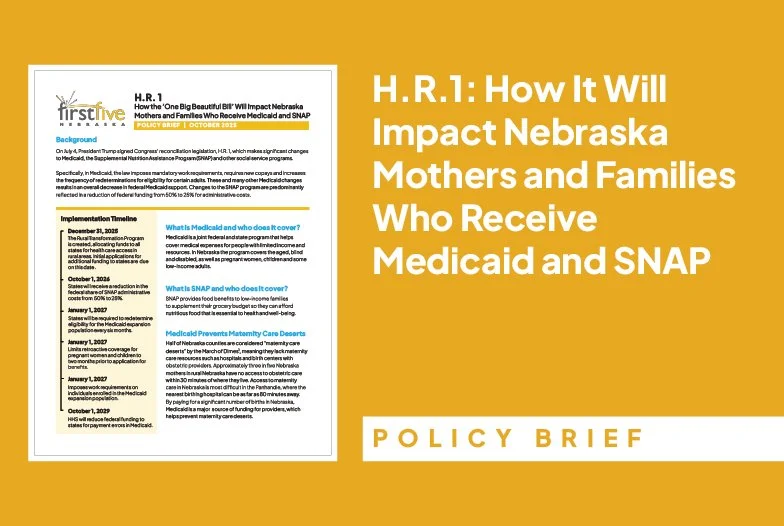
Educate Yourself
Download our policy brief on how Medicaid provisions in H.R.1 could impact Nebraskans.

Recognize Misinformation
Learn how to spot and respond to misinformation about Medicaid.
2026 Early Childhood Interim Studies
Interim Studies Give Lawmakers Information and Insight for Policy Action
Interim studies are in-depth policy research and information-gathering efforts conducted between sessions of the Nebraska Unicameral. They allow lawmakers to consult experts and review data to inform potential legislative action.
The following studies will be conducted during Nebraska’s 2026 legislative interim.
-
Play therapy is a well-established, evidence-based mental health approach that is especially effective with young children. LR382 will take a comprehensive look at what the research says about play therapy’s effectiveness, why many Nebraska families struggle to access it, how the state currently regulates it and the billing challenges providers have faced. It will also examine what education and credentials practitioners need, how other states handle play therapy and what changes to state law or policy might help expand access—including whether additional state funding would be needed to make those changes happen.
-
LR383 focuses on maternal depression and mental health, examining how many Nebraska mothers experience mental health challenges during pregnancy and after birth, and what impact those challenges have on babies and families. The study will assess available screening tools, provider capacity and insurance options, look at how other states approach the issue and identify potential changes to state law.
-
An estimated 26,000 Nebraska children under age four are at risk of “diaper need” — defined as when a caregiver can’t afford an adequate supply of clean diapers. LR391 will examine the ripple effects of diaper need on mothers, young children, health systems, workforce participation and child care. It will also review what resources currently exist in Nebraska and how other states address this issue.
-
LR393 examines whether Nebraska could provide universal, high-quality child care at no cost to parents, modeled after a similar program in New Mexico. The study will examine how New Mexico’s program works and what it has achieved, assess Nebraska’s current unmet need for child care and explore barriers to impelmentation.
-
LR412 focuses on child care financing and how the state can more strategically expand subsidies to improve access and affordability for working families. It includes a review of funding allocations that support child care assistance, the impact of quality, affordable child care availability on Nebraska businesses, current eligibility requirements for child care subsidies, reimbursement rate structures for child care providers and a review of federal and state funding streams that support child care assistance.
-
LR423 focuses on food insecurity among pregnant and postpartum women and their children—a significant concern given that 105,000 Nebraska households experienced food insecurity annually from 2021 to 2023, yet only 43% of eligible mothers participated in WIC in 2024. The study will examine barriers to food access, review available programs including WIC, SNAP and food banks, assess how those programs affect maternal health and birth outcomes, and identify potential policy or funding changes to strengthen nutrition support for families.
-
LR472 proposes a study of the Head Start and Early Head Start programs in Nebraska, which provide early childhood education and wraparound services for infants, toddlers, preschoolers and families. The study will survey the programs’ reach and impact in Nebraska, review their federal and state history, examine staffing challenges affecting service delivery, assess compliance with federal background check requirements and look at how other states support these programs with the goal of developing state policy recommendations to strengthen them.
Follow FFN on Social Media