
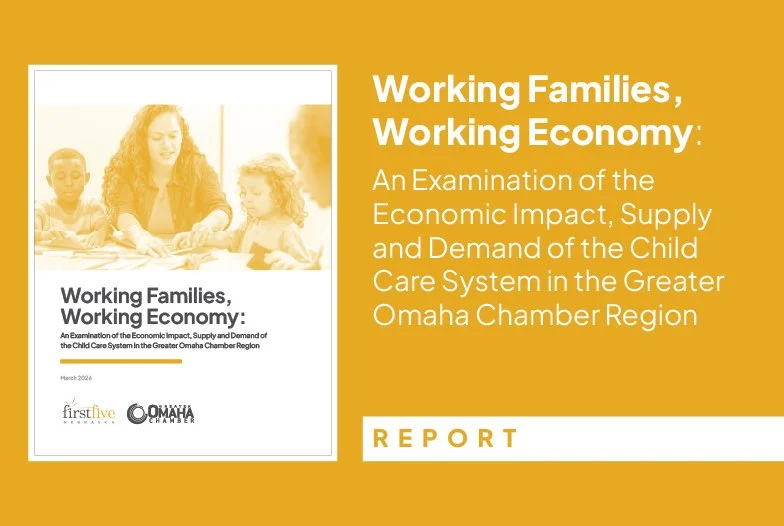
Working Families, Working Economy: An Examination of the Child Care System in the Greater Omaha Chamber Region
The Greater Omaha Chamber of Commerce commissioned First Five Nebraska to conduct a regional study to better understand the relationship between child care availability, workforce dynamics and the impact on the economy of the eight counties that comprise the Greater Omaha Chamber (GOC) region. The study revealed that the effects of inadequate child care in the region are significant:
$1.02 billion in lost business output
$919.2 million in lost labor income
A reduction of 3,909 regional jobs
The report also analyzes the factors that influence supply and demand of child care, including the role played by the early childhood workforce.
![[Video] Communities for Kids Success Stories](https://images.squarespace-cdn.com/content/v1/6927156f21a8ff18a037b922/1768490838926-MLB7CRWKTAYDV63A4XNE/Screenshot+2026-01-15+at+9.26.56%E2%80%AFAM.png)
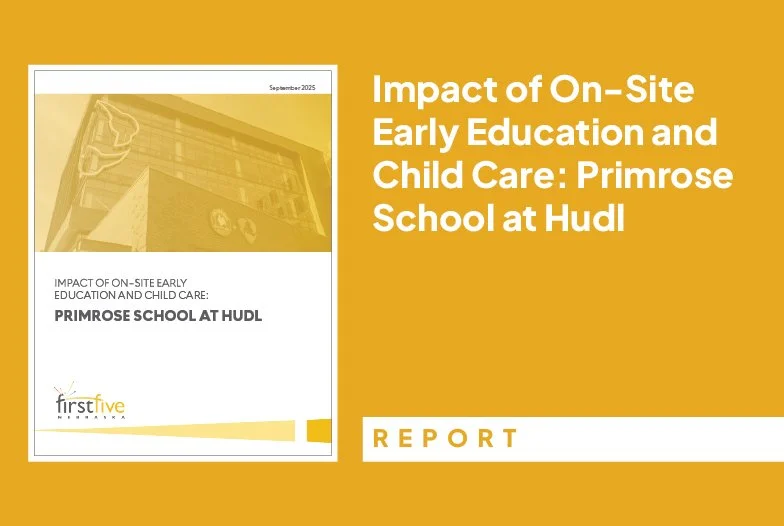
Impact of On-Site Early Education and Child Care: Primrose at Hudl
Primrose School at Hudl opened in July 2023 at Hudl headquarters in the Haymarket District of downtown Lincoln, Nebraska. The early education and care provider is open to the public, and Hudl employees receive priority enrollment and a reduced tuition rate as part of their employee benefits. The partnership between Hudl and Primrose Schools is an innovative example of a business-driven solution to provide greater access to high-quality child care options for Nebraska’s families, and therefore, current and potential employees.
![[Video] Haley’s story: Tell your senator to vote YES on LB304](https://images.squarespace-cdn.com/content/v1/6927156f21a8ff18a037b922/1766433739255-H02DHTP4NM8ML35DNL70/Thumbnail-Haleys-Story2.jpg)