
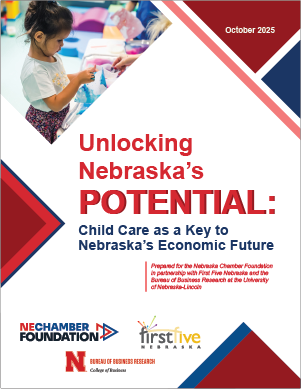
Unlocking Nebraska’s Potential: Child Care as a Key to Nebraska’s Economic Future
Access to child care is fundamental to our state’s ability to field a competitive, highly productive workforce while ensuring economic opportunity for hard working families throughout Nebraska. But as the expense of purchasing child care continues to grow faster than household incomes, parents face increasingly serious obstacles to staying employed, being fully engaged at their jobs and providing for their families. That comes at a heavy cost not only to families, but to employers and our economy as a whole.
Unlocking Nebraska’s Potential: Child Care as a Key to Nebraska’s Economic Future highlights how child care challenges are increasingly shaping the state’s workforce and economic well being. It updates earlier impact estimates published in the 2020 Bottom Line report, incorporates perspectives from business leaders and explores Nebraska’s child care issues in relation to neighboring states. This new analysis reveals:
Unlocking Nebraska’s Potential Report: FFN Follow-Up Webinar (11/21/25)
Direct and multiplied (“ripple effect”) losses of $1.74 billion to business output and $1.61 billion in labor income, resulting in a loss of $63.8 million in state tax revenue and a reduction of 6,843 jobs.
Direct and multiplied losses have approximately doubled since 2020, due to more parents needing to leave or change jobs due to child care concerns.
Employers acknowledge that even short-term disruptions in child care access interfere with productivity, recruitment and retention.
Nebraska has experienced the largest percentage decrease in child care workforce as compared to six other Midwestern states, exacerbating the child care shortage.
Exploring local and regional strategies
Unlocking Nebraska’s Potential Report: Nebraska Chamber Foundation Webinar
The Unlocking Nebraska’s Potential report also examines how various communities are responding to this challenge through multi-stakeholder collaborations and business-led initiatives.
Thayer County: Employers, nonprofits and families partnered to launch the Spring Creek Kids child care center, and support family child care home providers through employer-backed donations and Nebraska’s nonrefundable Child Care Tax Credit.
Norfolk: Daycos, Flood Communications, Elkhorn Valley Bank and Northeast Community College are participating in the Norfolk Area Childcare Collaborative (NACC) by jointly funding its operations and making child care slots available to company employees as well as the general public. NACC plans to open a new child care facility in 2026.
Gothenburg: Public, private and philanthropic partners collaborated to fund the Gothenburg Impact Center, housing an early childhood center among other community facilities. Development of the Center’s child care program involved coordinated planning with all local child care providers to ensure child care capacity could be expanded without displacing existing programs.
Lincoln: Hudl partnered with a Primrose School franchise to operate an on-site center, offering priority access and subsidized tuition to employees while also serving the broader community. Similarly, Bryan Health operates two on-site Child Development Centers—now managed by Bright Horizons—to meet employee demand with extended hours aligned to hospital work schedules.
Millard: Millard Public Schools Foundation created Spark, a school-based before-/after-school model providing convenient, reduced-cost care for school district staff and accessible programming for families year-round.
In addition to examining Nebraska-specific findings in a regional context, the report also explores economic policies implemented in three other Midwestern states that may serve as useful models. Michigan’s MI Tri-Share initiative targets child care affordability, Iowa’s Childcare Solutions Fund focuses on expanding capacity by strengthening the early childhood workforce, while Colorado’s EPIC Design Lab and Employer-Based Child Care grant assist employers in developing new facilities.
A resource for well-informed solutions
By refreshing the 2020 economic impact estimates, gathering insights from employers and examining how neighboring states structure their child care systems, the Unlocking Nebraska’s Potential report offers a deeper look at our state’s current needs and potential solutions. Together, the updated data and comparative policy examples serve as a resource for business leaders, policymakers and other stakeholders to chart effective strategies for addressing Nebraska’s child care challenges.