
by Mitchell Clark, First Five Nebraska Policy Advisor
When Nebraskans think about early childhood policy, their attention often turns first to the state Legislature. While state lawmakers play a vital role in legislative and state funding priorities, the Nebraska State Board of Education is an equally important partner in shaping the policies, regulations and funding decisions that affect our state’s youngest children and their families.
The State Board of Education oversees the Nebraska Department of Education (NDE), which administers key programs serving children from birth through age 5. From establishing standards for school and Educational Service Unit (ESU) pre-kindergarten programs under NDE’s regulatory code governing early childhood education, commonly referred to as Rule 11—to approval of state-funded Early Childhood Education Grant funds to schools and ESUs, cash fund spending authority approval of Nebraska’s signature public/private partnership program Sixpence serving vulnerable children birth to age 3 and administration of federally mandated services under the Individuals with Disabilities Education Act (IDEA) for infants, toddlers and pre-K students, the Board’s governance directly impacts early care and learning quality across the state.
As First Five Nebraska expands our direct policy engagement with State Board of Education members—mirroring the data-driven approach we use with state senators—we want to ensure policymakers and the public have clear, accessible information.
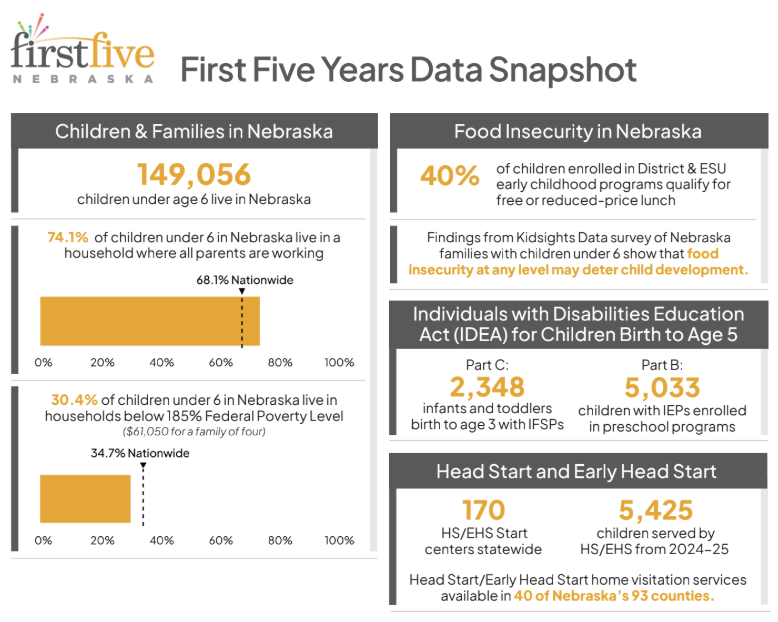
To support informed decision-making and public policy advocacy engagement, we have released a new First Five Years Data Snapshot. This statewide resource brings together essential demographics, program enrollment figures and funding trends relevant to the State Board’s oversight.
Key Takeaways from the Data Snapshot
Our new one-page overview highlights both the urgent need for early childhood support in Nebraska and the shifting funding landscape facing school- and community-based programs:
Working Families Rely on Early Care: Of the 149,056 children under age 6 living in Nebraska, 74.1% live in households where all parents are working—significantly higher than the national average of 68.1%. Additionally, 30.4% live in households below 185% of the Federal Poverty Level ($61,050 for a family of four)—a key eligibility level for federal programs such as the National School Lunch Program, which provides free and reduced lunch for students, including early childhood programs.
Food Insecurity Impacts Early Development: 40% of children enrolled in school district and ESU early childhood programs qualify for free or reduced-price lunch. Research from the Kidsights Data survey underscores that food insecurity at any level can deter healthy child development.
Public Programs Serve Thousands of Young Nebraskans: Across Nebraska, 954 Rule 11 early childhood classrooms operate within 234 programs. Under IDEA, 2,348 infants and toddlers (birth to age 3) receive early intervention services through Individualized Family Service Plans (IFSPs), and 5,033 preschoolers with Individualized Education Programs (IEPs) are enrolled in prekindergarten programs. Meanwhile, 170 Head Start and Early Head Start centers served 5,425 children in 2024–25, with home visitation available in 40 of Nebraska’s 93 counties.
Funding Pressures Are Growing: While total enrollment in public early childhood programs rose slightly (+0.5%) in 2024–25 compared to the prior year, total funding decreased by 2.5% to $166.7 million—driven by drops in state (-9.9%) and local (-12.2%) funding. Today, Nebraska ranks 45th in the nation for state spending on early childhood education programs.
Explore and Share the Resource
Whether you are a policymaker, an educator or a community advocate, understanding the state of Nebraska’s early childhood system is the first step toward strengthening it.
Download the First Five Years Data Snapshot (PDF)
Want to explore how other early childhood data breaks down in your specific area of the state? Visit our Legislative District Dashboard for district-by-district demographics and insights.