
New Report Shows Economic Impact of Child Care in Lincoln and Lancaster County
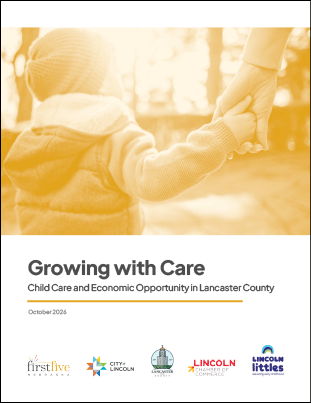
A new report highlights the economic impact of child care in Lincoln and Lancaster County, showing an estimated annual impact of $288.8 million in business output, including direct and multiplier effects. The report, “Growing with Care: Child Care and Economic Opportunity in Lancaster County,” also shows a loss of $264.2 million in lost labor income due to inadequate child care.
The City of Lincoln, Lancaster County, the Lincoln Chamber of Commerce and Lincoln Littles came together to sponsor the new report from First Five Nebraska. The report also evaluates the current child care system in terms of access, affordability and quality.
“The Lincoln Chamber has long believed that expanded child care options in Lincoln must be part of our workforce strategy,” said Jason Ball, President and CEO of the Lincoln Chamber of Commerce. “This study quantifies what Lincoln employers already understand. Families with adequate access to child care enables them to fully participate in the economy, and availability of child care strengthens Lincoln’s ability to attract new talent to our community.”
The report also shows that families earning less than $100,000 annually are more likely to experience additional economic challenges related to child care.
“When families can’t find or afford quality child care, it affects more than their budgets—it affects their ability to work, meet basic needs, and build a stable future,” said Anne Brandt, Executive Director of Lincoln Littles. “This report makes clear that child care is essential to the well-being of families and the economic strength of our community.”
Lincoln Mayor Leirion Gaylor Baird said the findings of the report affirm why the City of Lincoln has directed $2 million in federal and local funding toward early childhood education and why the city supports children and families through other initiatives.
“The findings of this report reinforce why this work matters and why we must continue looking for solutions that strengthen our workforce and support our families,” Mayor Gaylor Baird said. “We also know that no single organization can solve this challenge alone. It takes employers, child care providers, educators, government, families and community partners working together.”
Lancaster County Commissioner Sean Flowerday said the report also validates the work Lancaster County is doing through investments like the County’s Childcare Grant Program, which helps hard working families by providing financial assistance. Grant funding has not only assisted in addressing affordability, it has helped providers make improvements to classrooms, purchase learning materials and equipment and enhance staff development.
“The Growing with Care Report reinforces the importance of affordable, accessible, and high-quality child care in Lancaster County,” Commissioner Flowerday said. “Through committed funding to child care, Lancaster County is supporting working families, investing in stronger child care programs, and helping ensure our children have the safe, nurturing environments they need to thrive.”
Report author Dr. Katie Bass, Director of Policy Research at Early Futures Partnership, which includes the First Five Nebraska initiative, said, “Strengthening the child care system in Lancaster County requires data-driven solutions that take access, affordability and quality into account in equal measure. The fact that this report was created by bringing together the child care industry, the broader business community, the city and the county demonstrates that the leaders in the community are ready to do just that.”
Executive Summary highlights of the report
• The estimated annual impact of inadequate child care in Lancaster County, including both direct and multiplier effects, is $288.8 million in business output and $264.2 million in lost labor income. This leads to a reduction of 1,115 jobs in Lancaster County and $10.44 million estimated loss in income tax revenue for Nebraska.
• The child care gap in Lancaster County is 736, or 4.5%. This means there are 736 fewer child care slots within a reasonable driving distance than there are children who potentially need care.
• The number of child care programs serving young children in Lancaster County has decreasedsignificantly from 442 in 2019 to 329 in 2026 (-25.6%), but the total licensed capacity of theseprograms has changed very little during the same time frame, from 15,226 in 2019 to 15,331 in2026 (+0.7%). This reflects a shift in the child care market. There are fewer family child care homes (-35.2%) operating in the county than there were in 2019. And while there are marginally fewer child care centers (-3.7%), those programs are licensed to serve more children.
• The majority of parents in the region report their child receives at least 10 hours of nonparental care each week (63.4%). On average, parents are paying $296 each week for child care for one child. For parents with more than one child in care, the weekly price is $533. This equates to annual costs of $15,392 and $27,716, respectively.
• Parents earning less than $100,000 per year were more than three times as likely to say thatfinding child care was very difficult compared to those who earned more (14.3% and 4.3%,respectively). Regardless of income, nearly a third (32.5%) of parents who need child care reported at least some difficulty finding it, with cost being the most frequently cited reason.
• Families earning less than $100,000 per year were less likely to utilize nonparental care (45.1%compared to 75.9% for families earning more). For those who were using nonparental care, families earning less were more likely to quit or change jobs due to child care (16.5%, compared to 9.9% for families earning more).
• The annual turnover rate for the child care workforce in Lancaster County is 39.5%, and just 32%of the current workforce has been in the industry for at least six years.
Read the full report: Growing with Care: Child Care and Economic Opportunity in Lancaster County