
Growing with Care: Child Care and Economic Opportunity in Lancaster County
New report estimates the economic impact of inadequate child care to businesses, working families and Lancaster County as a whole.
Reliable child care is essential to working families and the broader economy. In Lancaster County, Nebraska, where three out of four children under age 6 have all parents in the labor force, the availability of child care directly affects parents’ ability to work, businesses’ ability to thrive and the local economy’s ability to grow. Child care providers, moreover, form the workforce that makes this economic activity possible.
For this system to support working parents and the businesses that depend on them, families need adequate access to child care that they can afford and trust to provide a high-quality environment where children can safely learn and grow. Yet the child care system too often falls short in one or more of these areas, leaving working parents without care that meets their needs.
Growing with Care: Child Care and Economic Opportunity in Lancaster County, sponsored by the City of Lincoln, Lancaster County, the Lincoln Chamber of Commerce and Lincoln Littles, estimates the economic impact of inadequate child care care and evaluates the region’s child care system through the interconnected lenses of access, affordability and quality. Together, these analyses show where the system meets the needs of working parents—and where gaps remain.
Key Findings
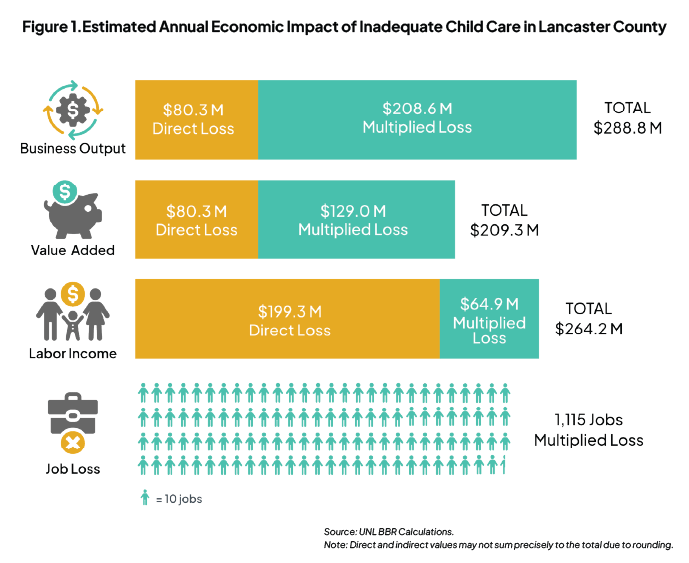
The estimated annual impact of inadequate child care in Lancaster County, including both direct and multiplier effects, is $288.8 million in business output and $264.2 million in lost labor income. This leads to a reduction in 1,115 jobs in Lancaster County and $10.44 million estimated loss in income tax revenue for Nebraska.
The child care gap in Lancaster County is 736, or 4.5%. This means there are 736 fewer child care slots within a reasonable driving distance than there are children who potentially need care.
The number of child care programs serving young children in Lancaster County has decreased significantly from 442 in 2019 to 329 in 2026 (-25.6%), but the total licensed capacity of these programs has changed very little during the same time frame, from 15,226 in 2019 to 15,331 in 2026 (+0.7%). This reflects a shift in the child care market, there are fewer family child care homes (-35.2%) operating in the county than there were in 2019. And while there are marginally fewer child care centers (-3.7%), those programs are licensed to serve more children.
The majority of parents in the region report their child receives at least 10 hours of nonparental care each week (63.4%). On average, parents are paying $296 each week for child care for one child. For parents with more than one child in care, the weekly price is $533. This equates to annual costs of $15,392 and $27,716, respectively.
Parents earning less than $100,000 per year were more than three times as likely to say that finding child care was very difficult compared to those who earned more (14.3% and 4.3%, respectively). Regardless of income, nearly a third (32.5%) of parents who need child care reported at least some difficulty finding it, with cost being the most frequently cited reason.
Families earning less than $100,000 per year were less likely to utilize nonparental care (45.1% compared to 75.9% for families earning more). For those that were using nonparental care, families earning less were more likely to quit or change jobs due to child care (16.5%, compared to 9.9% for families earning more).
The annual turnover rate for the child care workforce in Lancaster County is 39.5%, and just 32% of the current workforce has been in the industry for at least six years.
The data in this report is intended to spark a solution-driven conversation about child care challenges in Lancaster County. Building a supply of child care that meets the region’s demand will require solutions that address access, affordability and quality as mutually reinforcing pillars of a strong child care system.